

Always It Comes Around
Horror inspired by Stephen King’s “The Shining”

"Always It Comes Around" was submitted for consideration earlier this year for an upcoming anthology of works inspired by Stephen King's "The Shining.” There were undoubtedly thousands of submissions, out of which the editors are picking ONE story, so the odds were never good. My story made it through the initial cut-down stages but ultimately was not selected for publication. However, the editors said "only a small percentage" made it that far in the review process, which was a positive. There’s not really a market for Shining fan fiction, so here it is for the Substack world.
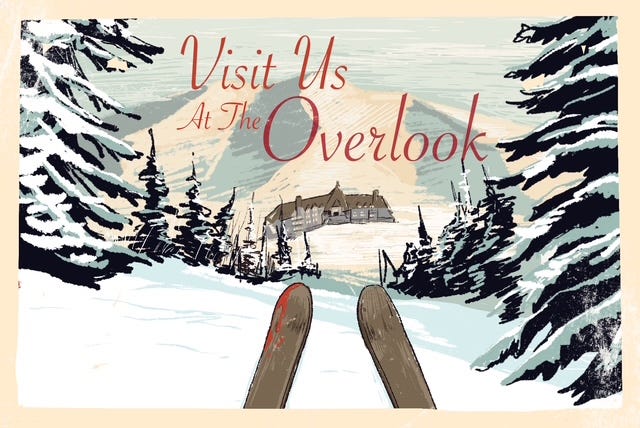
She clenched the restraining bar in both hands, ski tips bouncing, and twisted to look over her shoulder at the chairs sliding up Berthoud Pass behind us. Looking for someone. Her parents, perhaps. “Shit,” she whispered under her breath, then swung her head around as we neared the top of the lift. “Shit,” she muttered again, a tiny voice slithering towards panic. Hunger clawed my throat.
“You can have the rest of my sandwich?” she said, the way kids sometimes make everything a question. “But only if you tell me the fastest way to the lodge?”
She knew I was hungry without being told. Out loud, anyways. That was a start. I asked how old she was.
“Ten?” she told me.
“Ten is a little young to be left alone on a big mountain like this,” I replied, then asked her name.
“Frances? But take my sandwich, cuz you’re starving.” She tucked a mitten into the pocket of her coat and revealed the remains of a sandwich wrapped in wax paper. Every surface was smeared with the greasy slick of raspberry preserves and gobs of bread that had been pounded into a mash.
Frances, who knew my next meal was long overdue without being told as much. My jaw twinged. It had been forty days since the Turning – recruitment, if you prefer – and my insides said that couldn’t continue much longer. Dinner was waiting for me at home, I told her, but she could follow me to the lodge.
“What do you like to eat?” Frances asked as she slid the oily package back into her pocket and took another hurried glance downhill.
I lifted the bar, slid off the chair, and angled left towards the glades. Frances skidded to a stop and peered in the opposite direction.
“Is that the way to the lodge?” she shouted, her voice catching. Every tastebud fired, as if a sour candy was dropped on the back of my tongue.
“It’s a shortcut,” I answered, and pointed my skis towards the tree line.
Behind me, Frances slid both hands into the loops of her ski poles and shoved off in my direction.
“You really need to eat something,” she said.
And I did. Soon enough, I did.
#
23rd June 1948
It’s silly, you know – the entire concept. But I don’t have to tell you that, my sweet. No, someone like you doesn’t need to be told much of anything. We intuit things most people do not. Your sister shared the same talents, to a lesser degree. On occasion it’s that sense of déjà vu. Of knowing the Plymouth sedan is going to launch into oncoming traffic where it will be met head-on by a Freightliner bound for Topeka. We look away, the both of us, because we don’t need to watch to have seen it. Other times, it’s brushing arms with a stranger and their thoughts sizzle like a thunderbolt. Last fall we crossed paths with a dour woman while browsing in the produce aisle. Such a precious child, she mumbled, her eyes focused on the tops of her shoes. As we passed, a silent plea detonated in my mind. PLEASE HELP, MY HUSBAND IS GOING TO KILL ME. You felt her appeal as well, no doubt, judging by how your body jolted stiff. I avoided the papers for a few days, expecting that she was dead but choosing ostrichism over validation. Is this a word you know, ostrichism? Perhaps I shouldn’t assume. It means burying your head in the sand. Ignoring truths.
But that’s the crux, isn’t it? The willful ignorance of the truth?
We play the same game, you and I, but even as your mother, I’ve come to accept we’re not on the same team.
#
25th June 1948
You wanted to spend the summer at the beach. Begged to take the train west through the Rockies and not stop until your toes lost feeling in the bracing waters of China Cove or Mendocino. Pleaded for Bandon or Manzanita. As the day of our departure approached, you filed a late petition for somewhere, anywhere but Colorado. Summers would be rife with thunderstorms, you cautioned. Your classmate had been to Colorado and moaned it was the horror of their young life, you warned. At the library, you showed me books about the dangers of altitude. Books far beyond the level of a normal seven-year-old, which you are anything but.
My body craved the company of the Overlook, and it coveted ours as well. I was compelled to return by soaring peaks and endless forest. Lured by the chime of a brass gate pulled shut at the elevator. Enticed by impressive gentlemen whispering promises of lavish parties and sweet wines, their words invading my dreams and begging for my presence once more. Of course, we had the personal invitation from Mr. Derwent himself, in his typical unhurried longhand, that tilted the scales in favor of the Overlook.
To the lovely Missus Dorothy Miles,
It would be my honor to host you again this summer at the glorious Overlook Hotel. And please, I insist you bring that extraordinary young boy of yours. My associates and I have heard much about him, and we are eager to make his acquaintance.
Forever a friend of Dorothy,
H. Derwent
It’s nice to be desired, is it not?
And so we are here. As I write this, you suffer through a restless and fitful afternoon slumber. The bed in room 107 was not to your liking and the noise from the lobby was untenable, so at my request Mr. Derwent moved us to the second floor. Your sleep has not improved.
Today, just like the last, I’m drawn to your bedside while you rest – the force of a great magnet finding its opposite. Inches away, I’m awash in smells. The delicate citrus of your shampoo, the honey and lavender of skin lotion applied after a morning bath. The tang of sheets soaked in sweat. Your fingers are woven between the loops and twists of the black and white checked afghan my mother knitted to celebrate your birth seven years ago, a mirror of the pink and white version she made for your sister two years prior. And yet, the familiar whispers of the impressive gentlemen tickle my ear and in unison say eat, you must eat! My mouth is awash with saliva, and I think, can I? My stomach yearns for it.
You shine like a beacon, a meal that would sustain for months.
But you are my son.
I beg the whispers away. I shall be outside, enjoying the wonders of the topiary.
#
August 1944. Paris is on the verge of liberation and German forces are shattered by a Soviet offensive on the eastern front. Camp Carson is in full bloom outside Colorado Springs. In the shadow of Pike’s Peak, a woman and two small children sit in the grass near the playground behind Pearlman Elementary. Their arms are extended in front of them, as if each was carrying an invisible dinner tray. The midday sun sits high and fierce.
The girl is five years old. She wears a light grey plaid dress with a Peter Pan collar. The stain across the chest suggests cream of wheat for breakfast, with a dash of homemade jam. Her hair is auburn with flecks of delicate blond, and she possesses the same thin frame and pale complexion as the woman. She is her mother in miniature.
“Will we catch a flutterby, momma?” the girl asks.
Her mother smiles.
“Butterfly, darling.” She leans forward and places a kiss on her daughter’s forehead. “And perhaps we will, but we must remain still, and quiet.” She extends an index finger and taps the tip of the girl’s nose. The girl beams, then closes both eyes and resumes her vigil.
The boy does not have the patience to catch a flutterby. One suspender hangs loose from his waist, dislodged by an arm that preferred digging in the dirt to mimicking a tree branch. His button-down shirt has come untucked from the wool short pants, and one – no, both – shoes have been removed. He is three years old.
“Dada?” the boy asks, both hands gripping piles of unearthed rocks.
His sister opens an eye and risks a sideways glance at her brother, but remains silent. The woman turns to her son, places a hand on his cheek, and says, “Shh, my love. The butterflies will never visit us unless we are quiet.”
He stares at her, then tosses the rocks aside. “Where Dada?,” he says, louder this time.
“Dada is away, sweetheart,” she reminds him. “He went on the boat with the soldiers, remember?”
“WANT DADA!” the boy shouts, dragging his sister from her trance. She sighs. This is no way to catch a flutterby.
The boy continues to demand his father, his calls echoing off the oak surrounding the school. Tears well up in his mother’s eyes. She reaches for him.
“Come, sit with momma,” she says, her voice thick and failing. “Let’s have a snack,” she offers. “Yes, let’s have a snack,” she repeats, and pulls a package of crackers from her shoulder bag.
The boy climbs into his mother’s lap, thudding heart visible through the thinness of his shirt. The woman extends a hand towards her daughter, who tucks in alongside her brother. Swallowing a sob, the mother pulls her children tight to her chest and dots their heads with kisses.
“Dada will be home soon,” she assures them, her voice just a rustle. “He’s just away.”
The children grow heavy with the weight of sleep. Perhaps a nap would do them all some good, the woman thinks, and gingerly reclines in the grass, her son tucked under one arm and daughter nestled under the other.
“He’s just away,” she breathes. Her eyelids drop shut and exhaustion takes hold.
Deep asleep, the boy’s mouth trembles and a hushed phrase escapes his lips. “Flutterby coming,” he burbles, and buries his face deeper into the soft folds of his mother’s dress.
From the row of trees emerges an armada of brilliant iridescent blue and black wings. Pipevine Swallowtail, dozens of them, bounce and flicker through the warm air, seeking a resting place. They land weightlessly on the shoulders and legs and chests of a mother and her children dozing in the afternoon sun.
#
26th June 1948
The girl Frances was my first. Deep in the glades, our skis leaning against a tree a few feet away, I dragged her to the snow and jammed the fingers of my glove down her throat. Fumbling like a newborn seeking its mother’s breast, I tore the balaclava away from her neck and sought out the tenderness of the skin below as she thrashed beneath my weight. The terror, the tension of every muscle in her tremoring body, was the ringing bell.
“You should have turned right and never looked back,” I hissed, and withdrew a small blade from my jacket, waving it inches from her nose. Tears poured down her face. It was time. Ravenous, I pressed the tip under her right ear and drew it across to the left, but haste and inexperience left me unprepared for the sudden release. I gulped at the vapor rising from her gaping throat, pawing the air towards my mouth like a street dog gorging on found meat. But so much steam was wasted, lost in the thin air of Berthoud Pass.
This must be hard for you to read. To learn who, or more precisely what, your mother is.
My body throbbed with energy after taking steam for the first time. Aches and ailments disappeared overnight. Skin grew taut and fresh, hair thickened and threads of grey vanished. But I was wracked with guilt. To think of her family, losing a child so young and in such a horrific fashion? Never again, I told myself in the days that followed.
It was a promise I could not keep. The hunger refused to go silent.
After the fiasco with young Frances, each feeding was more refined than the last. My skills soon allowed me to release the steam in a dribble, just enough to savor an inhale or perhaps a mouthful, like enjoying tapas in Spain or filling your lungs with the saccharine air of a candy shop. Or, keep them alive for days on end, rationing the steam when food was likely to be in short supply. Most of these skills were self-taught, of the trial-and-error variety, because I rarely spent time with the others. There were, and still are, others, but their nomadic lifestyle does not mix well with motherhood or family. But they were handy in the early days for a pinch of insider knowledge. The canisters, for example? Unknown to me, until a chance encounter outside Glenwood Springs gifted me the expertise to harness the steam I couldn’t, or chose not to, consume in the moment, preserving it for later use.
The cedar chest at the foot of my bed contains a collection of canisters. Most are empty, though two hold what remains of the twins, Shirley and Joyce O’Dell. You remember the O’Dell’s, yes? Each no bigger than a pound of soap after a hard day’s washing. Classmates of yours who set out for the grocer but were lured into the trees by the want to find a missing dog. Their shine wasn’t strong enough to feel that there was no dog, though I’d like to think my acting job could lay claim to a share of the credit.
Mouthfuls of dirt and rock muffled their cries as my blade traced from ear to ear, leaving a gushing slit in its wake. Such brittle bones.
I’m not proud of what I am.
#
27th June 1948
Afternoon sun pours through the paned glass of the Overlook, washing over your milky skin. Your arms twitch in a disturbed sleep. Watching the fragile cage of your chest rise and fall, rise and fall, my thoughts drift to when you stood at my bedside and said, “Daddy’s guts are on the outside.”
I asked what you meant. “Daddy’s guts are on the outside,” you repeated, burying your face in my shoulder.
Days later the telegram arrived. It is with regret that I am writing to confirm the death of your husband, Corporal William Miles, who was killed in action on 6 June 1945 in Okinawa…
Some may have dismissed it as coincidence or the ramblings of a child who longed for his father to be home. But not I. You had seen it, my sweet. Daddy’s guts were laid out in the sand like a rummage sale, put there by the burst of a Japanese mortar, and you saw it happen.
My suspicions had been there since you toddled. When asked to draw a picture of our family, you scrawled four stick figures flanked by a brown pup with huge, floppy ears. We didn’t have a dog, until we did; Daddy arrived home hours later with a stray Basset Hound that had wandered through the base. Brown, with the biggest floppy ears we’d ever seen. Thumper, your sister named him. Or the night screams of Nana! Nana! echoed from your room. I bolted down the hall and found you standing in front of the wooden rocker where my mother had so often cradled you to her chest before bed. Your skin was mottled with gooseflesh. Nana! Saw Nana! you shrieked, pointing at the chair. We woke early the next morning to a knock on the door and received the news my mother had passed during the night. As you grew older, the visions grew more distinct. Often it was simple and pure – Snoopy Sniffer!, you shouted, holding the present aloft before it had been unwrapped. Other times, it was troubling.
Robert won’t be at school anymore because his brain will die.
Miss Tucker has a baby in her belly, but it won’t be born.
Sissy has a clown smile on her neck.
And you were right, always.
You shined, brighter than the O’Dell’s, brighter than Frances, brighter than your sister, brighter than dozens of others, and when you saw Daddy die, I knew there was no greater threat to you than me.
And yet still, I brought you to this place. Our home was a shattered husk without Daddy, full of shadow when before there had been light. The need for an escape hatch, for a place that was vehement in demanding our presence, was overwhelming. The Overlook filled that need. I insist you bring that extraordinary young boy, Mr. Derwent had written. We are eager to make his acquaintance.
Yes, it’s nice to be desired.
Your eyelids flutter and both legs spasm, twisting the bed sheets into a clump. I lay my head to your chest and feel the frantic metronome of your heart, then grow nauseous as an image blooms before me. Seated at the head of a grand table in the ballroom, the impressive gentlemen hang over my shoulders. In front of me lies a large aluminum dome with a wooden handle. Eat, you must eat!, the gentlemen urge. Their lips caress my neck as a bony hand presents me with an opaque pearl handle topped by a two-inch steel blade, then motions to the smoldering platter in front of us. The chorus grows louder as my fingers wrap around the handle and the dome is lifted, revealing the platter beneath. On it lies a body, a boy, with pale skin and frail shoulders, clutching a black and white checked afghan. EAT, YOU MUST EAT, the impressive gentlemen thunder. I touch the blade beneath the boy’s right ear, preparing to draw it across, and feel the press of the gentlemen on my back, their voices now just a seduction. Yes, eat, they soothe, as they explore my breasts and work to separate my thighs. My breath grows ragged and harsh, my hips rise to meet their touch, and a bead of crimson appears where the tip of the blade has broken the skin.
MOMMA! you cry out, and the image explodes like dropped china. Gone are the lustful touches and urgent appeals of the impressive gentlemen. It is quiet in our room. Your brow glistens with sweat, yet you shiver. I tuck the blanket around your body. Out the window a group of ladies promenade towards the roque court.
I haven’t eaten in days. Your nearness torments me.
Medoc, are you here? It’s me that I fear.
#
28th June 1948
My thoughts grow darker than a stack of black cats.
Here I sit watching you sleep. The eaves of the Overlook shudder and stained-glass windows rattle from the vigor of afternoon thunder booming across the mountaintops. Today there is no roque. There is no admiration of topiary beasts or stunning vistas. Instead, I am besieged by perpetual mutterings. Faceless voices so close their breath puffs across the nape of my neck. Eat, you must eat, they say. “Show yourself,” I shout, a demand that is met with laughter not with but at.
From the bathroom echoes the sound of something falling from height and smacking to the floor.
Tink tink.
I rise from your bedside to investigate.
She creeps she creeps, you rasp from behind me. Your voice, there can be no mistake, but I wheel around to see you still at rest, arms clasped around the checked afghan. A shiny trail of spittle escapes your lips.
Laughter erupts. It is everywhere but nowhere.
I wish we had gone to Mendocino.
Tink tink.
My mind curls as I stride to the bathroom and throw the door open. There, on the tile, lays a small steel blade, revolving slowly as if in a game of spin the bottle. The blade that opened the throat of young Frances, who was separated from her parents on a ski trip. The blade that peeled back the gullets of Shirley and Joyce O’Dell, who were looking for a dog but found the everlasting instead. The blade that carved a ghastly, dripping clown’s mouth beneath your sister’s precious smile as she experienced first-hand what her mother had become. The blade that released the steam of innumerable children, delicious and shining and horrified. The same blade I dared not bring when we departed for the Overlook, instead locking it in the cedar chest.
Yet there it sits, gleaming.
Eat, you must eat, the impressive gentlemen crow, their voices radiating from the tub, from the closet, from within the walls.
The rotation of the blade stops, the pearl handle aimed at my quivering hand.
Hunger wells up from deep within and I am overcome. Kneeling, my fingers grasp the handle, cool and heavy in my palm. Countless hands probe my body and tangle in my hair, eat you must eat, she creeps she creeps, extraordinary young boy and a force pushes me to your bedside.
Now I stand above you, dining on the soft exhales of your sleep. My hand squeezes the handle of the blade, knuckles blanched white. My nipples grow firm under the desperate circling of so many unseen thumbs and wetness blossoms between my legs. She creeps she creeps, eat you must eat and the steel tip of the blade meets the smoothness of the skin beneath your right ear as my hand presses down.
A bead of crimson reveals itself.
Laughter overwhelms. EAT, YOU MUST EAT, SHE CREEPS SHE CREEPS, WE ARE EAGER TO MAKE HIS ACQUAINTANCE the impressive gentlemen roar. Blood pulses through every limb, my body yearning for the meal that is to come.
Transfixed, I watch a sputtering, oozing grin appear across your neck. EAT, YOU MUST EAT the impressive gentlemen growl through lips that slide between my breasts. Your eyes flicker open and meet mine. Panicked air fills your lungs, but your cry of MOMM- is cut short as the blade completes its arc and your throat splits open as if a sausage left to roast too long above the coals. From the cherry-red line bursts a flood of steam and the street dog inside me devours your energy. Pausing not to gather myself, I feast on the unrelenting surge. Belly full and mind swimming in delirium, I begin to withdraw, but a skeletal hand shoves my head back to the pulsing wet of your throat and the Overlook heaves with joy.
Medoc, are you here? I’ve been feeding on children, my dear.
#
29th June 1948
What a scene you have happened upon, Mr. Derwent. My sincerest apologies to your room attendants for what will undoubtedly be a prolonged and unfortunate undertaking. Might I suggest hydrogen peroxide for the bedsheets? Though perhaps everyone would be best served if the linens found themselves ablaze in the boiler.
Please accept my eternal gratitude for your hospitality, generosity, and willingness to ensure my son and I had all the comforts we desired. Our stay at the Overlook was quite spectacular, and I depart most satiated, much like the prior visit with my dear daughter.
The ever-present itch in both nipples foretell that I am expecting again, and with God’s grace I shall bring another healthy, glowing child into the world!
Adieu, Mr. Derwent. It is with much anticipation that I look forward to our next encounter.
#
29th June 1954
Yes, my sweet child, here we are at the Overlook, at last! Regretfully, Mr. Derwent is no longer present; how I do wish you could have met him. He so adored your sister and brother, may they rest in peace.
The afternoon storms of summer rage outside our second-floor window, but you remain lost in a broken and agitated sleep. Your legs pinwheel, tossing sweat-soaked bedsheets onto the carpet. I lay my hand across your chest to feel the drumbeat of your vigorous heart and lean close to draw your gentle aroma deep into my lungs.
Eat, you must eat, a familiar voice whispers. From the bathroom echoes the sound of something falling from height and smacking to the floor.
Tink tink.
I rise from your bedside to investigate.
Don’t feel bad. Chuck said they made room for one story from an unknown writer.
The decision to root this in Doctor Sleep's mythology rather than leaning on the Overlook's more familiar haunted-house mechanics was genuinely smart.
Dorothy as a maternal True Knot figure feels both fresh and real. The butterfly scene is the best thing here. That tenderness makes everything after it, way darker.
Beautifully written.
I have an Overlook piece which is mostly finished but felt it was too stock. It focused on the Indian road crews and a down on his luck shell shocked veteran, trying to keep the road open while the Overlook was under renovation.
It also peered into Derwent's true obsession with the overlook. But nothing as original as this.
Well done again.